
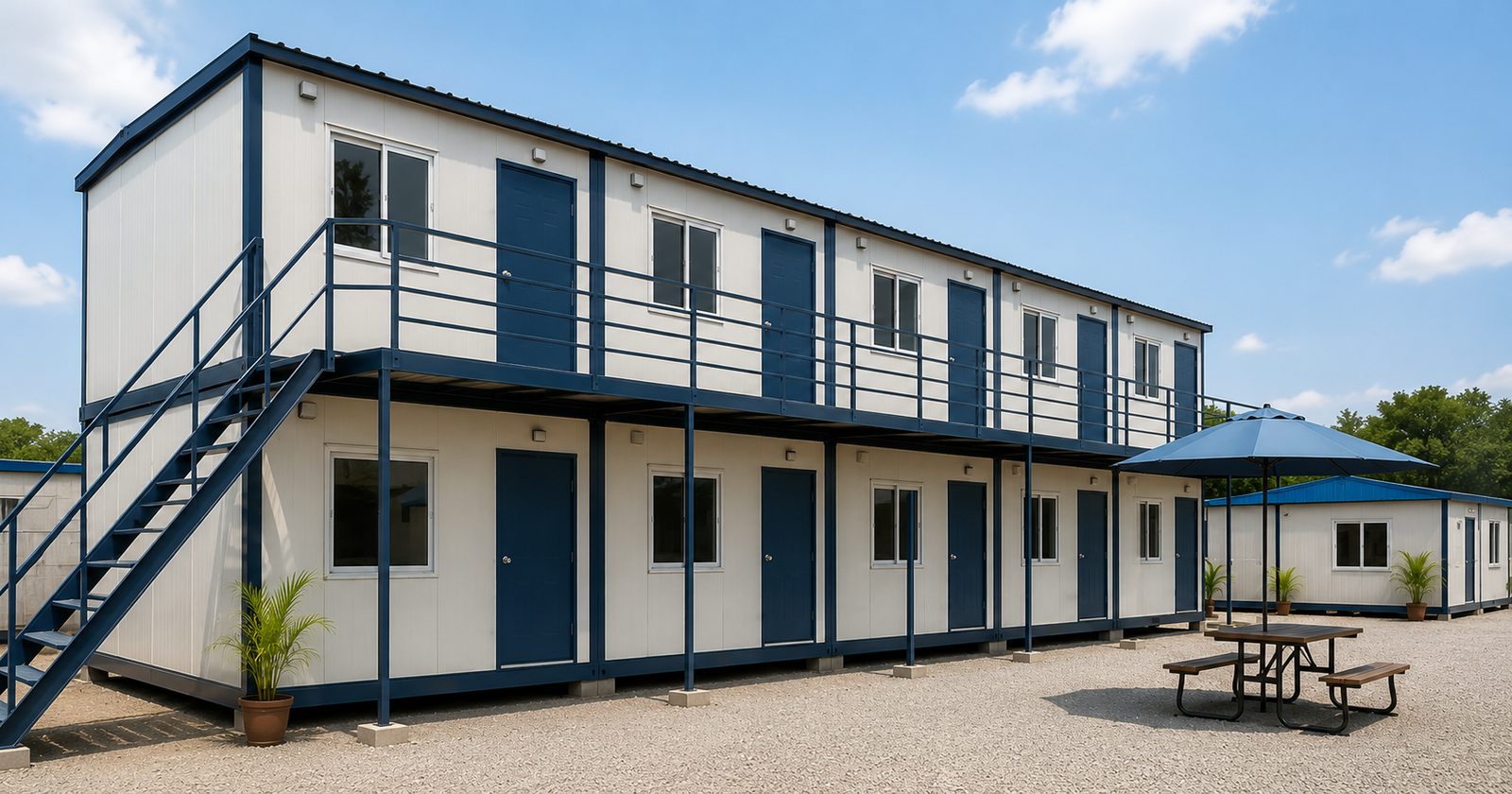
Portable bunk houses are being considered as a practical solution in labour camps. These are much easier to use to accommodate workers in modern labour camps. Companies need temporary housing as the project may move into temporary locations. So portable bunk houses are the best solution because they are safe and quick to assemble in a limited amount of time. They can be expanded and relocated anywhere according to the project’s demand.
Coming to the labour camp, these bunk houses are the backbone of worker welfare. These structures can offer ventilation, kitchen units, and a sanitary block, all under an umbrella. They meet all the basic amenities. They are customizable and can be brought to any geographical region, like construction sites, mining, and industrial projects. This guide will assist you with the key features of safety and customisation options for portable bunk houses.
What is actually a Portable Bunk house?
Portable Bunk houses are prefabricated portable cabins that offer accommodation for workers in remote labour camps. They provide safety and comfort for the workers. These are applicable when permanent buildings seem to be impractical on sites like construction, oil and gas, mining, etc.
Normally, portable bunk houses are made up of a mild steel frame with insulated wall panels. So they can withstand outdoor weather conditions. The interior of bunk houses is customizable to meet needs such as climate control. They generally provide basic lighting, ventilation, and attachable toilets.
Advantages of Using Portable Bunk Houses
There are several advantages to using portable bunk houses. Some of them are listed below.
- They are quick to install and are factory-made. Their ready-to-deploy nature makes it easy when starting a new project site.
- They can be relocated to the next site after finishing the project, which means a reduction in long-term accommodation costs.
- More portable bunks can be set up stacked for up to 500 workers with sanitary blocks and dormitories.
- These labour accommodations are cheaper than permanent RCC structures.
Features of Portable Bunk Houses
Prefab labour accommodations share some common features with those of other manufacturers of portable bunk houses.
Exterior features of portable bunk houses
- They are embedded with an MS frame with insulation and sandwich panels for the roof that offer strength and thermal insulation.
- The standard sizes of portable bunk houses are about 6 meters and 12 meters in length. The height and width are 2.8 metres and 3 metres, respectively.
- They are resistant to weather and corrosion. Highly suitable for robust conditions.
Interior features of prefab labour accommodations
- Bunk beds are arranged for up to 8 persons per module.
- Made for comfort by providing ventilation, electric lighting, and climate control like ACs and fans.
- The bunkhouse units are made with separate toilets and shower units. Small shops and canteen blocks are also included for daily needs.
Are You Planning a Labour Camp? Check Out the Important Considerations
Portable Bunk Houses are the best options if you are planning a labour camp. More than just buying the cabins for a labour camp, it needs strategic planning. Important planning considerations are given below.
- The first one is site selection. Better to choose elevated land that is away from flooding risk and soil erosion. Also, look for safer access to a road.
- The bunk houses should be in an organised manner, providing space for fire safety and emergency exits.
- Choose a reliable water supply, drainage, and waste management. So that water cannot interfere with the electrical systems.
- To support the basic needs of labourers, add support infrastructures like canteen units, toilets, and small shops.
A good labour camp is a necessity for the success of your project because it improves productivity and morale. Labourers can work efficiently if they get good sleep and basic amenities.
Different Types of Portable Bunk Houses
- A standard type of portable bunk house includes a single-story cabin with bunk beds and standard lighting.
- Another one is a container-type bunk house that uses a steel structure and internal fit-out. They are mostly used in sites like construction and oil and gas.
- The third one is a bunkhouse with a pantry, which is a cabin with pantry space. Applicable to sites needing cooking facilities.
- Modular bunk houses are also a common type of prefab module that is attached to external stairs and balconies.
- The last one is a dedicated toilet cabin that has separate units for toilets and bathrooms. Used for hygiene facilities in huge camps.
Safety and compliance of portable bunk houses
Here are some key points about the safety and compliance of prefab labour accommodations.
- Please ensure that cabins have structural certification. If they are stacked modular colonies, make sure that they are stable and perfectly engineered.
- Also ensure fire and electrical safety. Make a way for evacuation paths between the bunk houses.
- Wastewater management helps to reduce water pollution.
- Make sure the interior design is perfect for easy cleaning and sanitation.
Details About the Cost and Customisation
Portable bunk houses are available at different price margins depending on the quality, size, and materials used.
- In Indian markets, cabin price ranges are typically listed from thousands to several lakhs for one unit.
- Buyers can make changes to the cabins depending on their needs. AC systems and attached toilets can be added.
- The investment in bunk houses pays back when you use them across multiple projects. It reduces construction time and can be relocated.
Conclusion
Portable bunk houses are chosen by many as the best practical solution for modern labour camps. The projects can move to remote and temporary locations. So companies prefer accommodation for labourers that is safe and quickly deployable. A portable bunkhouse is indeed for basic labour needs. For the contractors and project owners, this guide gives key aspects of various features and advantages of Portable bunk houses. These cabins are an ideal choice for temporary labour accommodation.
FAQs
1.What are the uses of portable bunk houses?
Portable bunk houses can be used in mining sites, oil and gas fields, and other temporary project locations.
2.Up to how many workers can be accommodated in one portable cabin?
Normally, up to 8 workers can be accommodated in a single cabin.
3.What are the normal customisations done in a portable bunk house?
They are particularly customised for attached toilets and air-conditioning.
4.What is the time period to install the Portable Bunk House?
Typically, a few days after the delivery.
5.What are the important factors that need to be checked before buying a portable bunk house?
Buyers must check the safety standards and the reputation of the manufacturer.
Also Read : Government/GST rules for portable cabins in India