
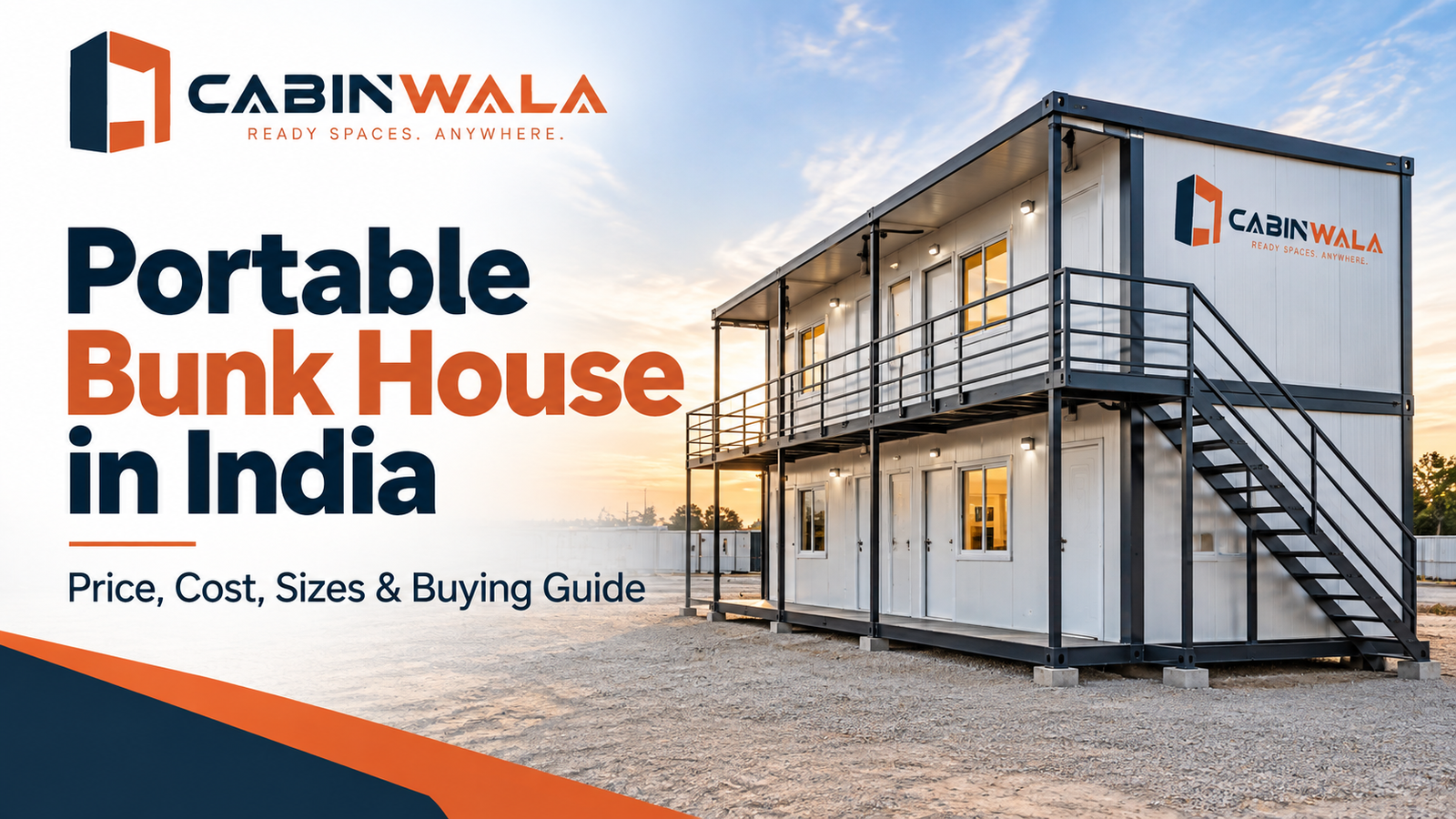
A portable bunk house is usually planned when a project needs accommodation at the site without putting up a permanent building. Construction sites, industrial projects, mining areas, infrastructure works and remote camps may need sleeping space for workers or staff for a fixed period, while the site itself can change later.
The difficult part is not simply choosing a cabin with beds. The size, number of occupants, insulation, ventilation, electrical fittings, sanitation, transport and unloading arrangements all affect the final specification and cost.
CabinWala manufactures portable cabins and prefab structures in Jaipur and supplies them across Rajasthan and India. Its bunk house range is designed for labour and staff accommodation, including temporary and remote-site requirements.
This guide explains how to plan a Portable Bunk House, what goes into the Portable Bunk House price, how to compare quotations and what should be checked before the unit reaches your site.
Portable Bunk House Price in India: What Decides the Price?
There is no useful single price for every portable bunk house. A four-person sleeping unit with basic electrical fittings is a very different project from a larger accommodation block with insulated walls, multiple bunk beds, toilets, showers, air-conditioning provision and customised interiors.
CabinWala currently handles bunk-house requirements through project-specific specifications rather than publishing one fixed bunk-house price. The quotation can therefore change according to:
- Overall dimensions
- Number of occupants
- Steel structure and exterior material
- Wall and roof construction
- Insulation requirement
- Flooring and interior finish
- Number and type of bunk beds
- Doors and windows
- Electrical fittings
- Fans or AC provisions
- Toilet and shower facilities
- Water and drainage requirements
- Transport distance
- Site access and unloading requirements
- Installation work
- Custom layout or additional fittings
This is why two quotations carrying the same words — “8-person bunk house” — may still have very different totals.
The better comparison is not simply which supplier has the lowest Portable Bunk House price. Compare what each quotation actually includes.
Portable Bunk House Sizes for 4, 8 and 12 People
Occupancy should be decided before the manufacturer starts fabrication. It affects the internal layout, circulation space, ventilation, storage and number of electrical points.
| Occupancy | Practical Planning Approach | Typical Requirements |
| 4 people | Compact accommodation unit | 2 bunk beds, storage, ventilation, lighting and basic electrical fittings |
| 8 people | Medium workforce accommodation | 4 bunk beds, better circulation space, storage and additional ventilation |
| 12 people | Larger shared accommodation | 6 bunk beds, wider circulation planning, more electrical points and stronger ventilation provision |
These are planning examples, not fixed CabinWala models. The actual layout should be prepared around the available site, bed dimensions, access, windows, storage and utility requirements.
4-Person Portable Bunk House Layout
A smaller unit can work well when accommodation is required for a limited crew. Two bunk beds can be arranged with a central or side circulation path, depending on the cabin dimensions.
Storage should be considered at this stage rather than added later. Even basic lockers or shelves can make a noticeable difference in a shared sleeping space.
8-Person Portable Bunk House Layout
For eight occupants, four bunk beds require more careful planning. Windows, doors, fans, electrical points and walking space should not be treated as afterthoughts.
If the unit will be used for longer periods, provisions for lockers, charging points and better ventilation are worth discussing before fabrication.
12-Person Portable Bunk House Layout
A 12-person unit needs more than simply adding four additional beds. Occupancy affects ventilation, circulation, lighting, storage and sanitation.
For larger workforce accommodation, it may also make more sense to divide sleeping areas into multiple modules instead of creating one crowded room.
Portable Bunk House Cost: What You Actually Pay For
The Portable Bunk House cost is made up of several separate components. Asking for these items to be clearly mentioned in the quotation makes comparison much easier.
| Cost Component | What It Covers |
|---|---|
| Steel structure | Main frame and structural members |
| Walls and roof | Sheet, panel or other specified construction |
| Insulation | Glasswool, Rockwool or selected insulation system |
| Flooring | Floor base and selected finish |
| Bunk beds | Number and type of beds |
| Doors and windows | Frames, shutters, glazing and hardware |
| Electrical work | Wiring, lights, switches, fans and other fittings |
| Plumbing | Water supply, drainage and sanitary connections where required |
| Interior work | Partitions, storage, lockers and finishing |
| Transport | Movement of the completed unit to the project location |
| Unloading | Crane or other unloading arrangement where required |
| Installation | Placement, joining, fixing or final setup |
| Customisation | Special dimensions, layout or additional facilities |
Not every project needs all of these items. A basic accommodation unit may have fewer facilities, while a long-term workforce camp may require toilets, showers, air-conditioning provisions, additional storage and more extensive electrical work.
That difference should be visible in the quotation.
Portable Bunk House Insulation for Different Indian Climates
Insulation should be selected according to where the bunk house will operate, not simply added as a standard specification.
Hot and Dry Areas
For locations such as Jaipur and other parts of Rajasthan, heat entering through the roof and walls can make an uninsulated sleeping area uncomfortable. Good roof insulation, appropriate ventilation and sensible window placement should be considered together.
Coastal Areas
Coastal sites bring heat, humidity, moisture and potentially corrosive conditions. The exterior material, protective coating, joints and insulation system should therefore be selected with the site environment in mind.
Cold Areas
In colder regions, the focus shifts towards reducing heat loss. Wall and roof insulation, properly sealed openings and suitable heating provisions should be discussed during design.
CabinWala lists Glasswool and Rockwool among its insulation options, with the final choice depending on the requirement.
Portable Bunk House Manufacturing, Delivery and Installation
A portable accommodation project should be planned in stages rather than treating delivery as the only deadline.
Requirement and Layout
The manufacturer needs the basic project information first:
- Number of occupants
- Required dimensions
- Sleeping arrangement
- Site location
- Expected duration of use
- Insulation requirement
- Electrical requirements
- Toilet or shower requirement
- Transport access
Design and Quotation
Once the requirement is clear, the layout and specification can be finalised. This is the point at which the buyer should check exactly what is included in the quoted Portable Bunk House cost.
Manufacturing
CabinWala manufactures its portable structures in Jaipur. Fabrication, insulation, interior work and fittings can be planned before the unit is dispatched to the site.
Transport and Installation
The finished structure is transported to the project location and installed according to the agreed arrangement.
The actual production and delivery period will vary with the size, quantity, customisation and site location. Instead of relying on a generic “delivery in X days” promise, ask for the manufacturing and dispatch timeline for your specific order.
Portable Bunk House Site Requirements Before Delivery
A finished bunk house can still face delays if the site has not been prepared properly.
Before dispatch, check:
- Whether the entry road can accommodate the transport vehicle
- Whether the final placement area is level and accessible
- Ground condition and drainage
- Space required for unloading
- Crane positioning, if required
- Overhead electrical wires
- Trees, walls or other obstructions
- Distance from the unloading point to the final position
- Water and drainage connections
- Electrical supply point
- Access for future maintenance
Crane unloading deserves particular attention. The lifting arrangement should be discussed before the unit leaves the manufacturing facility so that the required equipment and working space are available when it arrives.
Portable Bunk House Relocation and Reuse
One of the practical reasons for choosing a portable structure is that the accommodation may not need to remain at one location permanently.
If the project moves, the unit can potentially be dismantled, transported and installed again, provided the design and handling method support relocation.
However, relocation should be planned from the beginning. The manufacturer should be informed that the unit may be moved later so that access, joints, lifting points and packaging requirements can be considered.
Do not assume that every permanently modified unit can be relocated without additional work.
Portable Bunk House Safety and Construction Standards
Safety should be considered at the design stage, particularly when the unit will accommodate several people.
Depending on the project and location, the design team should consider applicable requirements covering:
- Structural stability
- Wind loads
- Earthquake considerations
- Fire and life safety
- Electrical safety
- Natural ventilation
- Plumbing and sanitation
- Safe access and exits
- Site drainage
Portable Bunk House Manufacturer in Jaipur: CabinWala
CabinWala is a Jaipur-based manufacturer of portable cabins, bunk houses, containers and prefab structures. The company was founded in 2022 and states that it handles design, manufacturing, transport, installation and maintenance in-house.
Its published product range includes bunk houses for labour and staff accommodation, along with portable office cabins, security cabins and portable toilets.
For buyers in Jaipur and Rajasthan, local manufacturing can also make discussions around site dimensions, transport, unloading and installation more straightforward. CabinWala states that it delivers and installs across Rajasthan and India.
The company also lists MS/GI sheet construction and Glasswool/Rockwool insulation among its material options, with customisation available for size, layout, finishes, electrical requirements and other project specifications.
Also Read:
| Portable Cabin Price in India: Complete Cost Guide by Size, Type & Material |
| Portable Bunk Houses for Labour Camps |
FAQs
How many people can stay in a portable bunk house?
The occupancy depends on the cabin dimensions, bunk-bed arrangement and available circulation space. Four-, eight- and twelve-person layouts can be planned, but the final capacity should be decided from the actual design rather than the number of beds alone.
Does a portable bunk house need a permanent foundation?
Not necessarily. The site preparation and support arrangement depend on the unit design, ground condition, location and project requirements. The manufacturer should confirm the required base or support system before installation.
Can a portable bunk house be relocated?
Portable bunk houses can be designed for relocation, but the process should be planned before fabrication. Transport access, lifting, dismantling, packaging and reinstallation all need to be considered.
Can toilets and showers be added?
Yes, toilet and shower facilities can be included when the layout and utility connections are planned accordingly. Water supply, drainage and sanitation should be finalised before manufacturing.
What information is needed for a Portable Bunk House quotation?
The manufacturer should know the required occupancy, dimensions, site location, insulation, electrical requirements, sanitation requirements, preferred layout and delivery conditions. More precise information generally produces a more useful quotation.
How should a portable bunk house be maintained?
Regularly inspect the roof, exterior coating, doors, windows, electrical fittings, plumbing and drainage. In high-use labour accommodation, cleaning, ventilation and periodic inspection are especially important.
Final Takeaway
A portable bunk house should be planned around occupancy, climate, site conditions and actual usage, not just the number of beds.
Before requesting a quotation, decide how many people will stay, what facilities they need, where the unit will be installed and whether it may be moved later. Then compare quotations using the same dimensions, materials, insulation, fittings, transport and installation requirements.
For projects in Jaipur, Rajasthan or other parts of India, CabinWala provides a local manufacturing option for customised portable bunk houses and related prefab structures. The right specification matters more than choosing a quotation simply because its headline price is lower.