
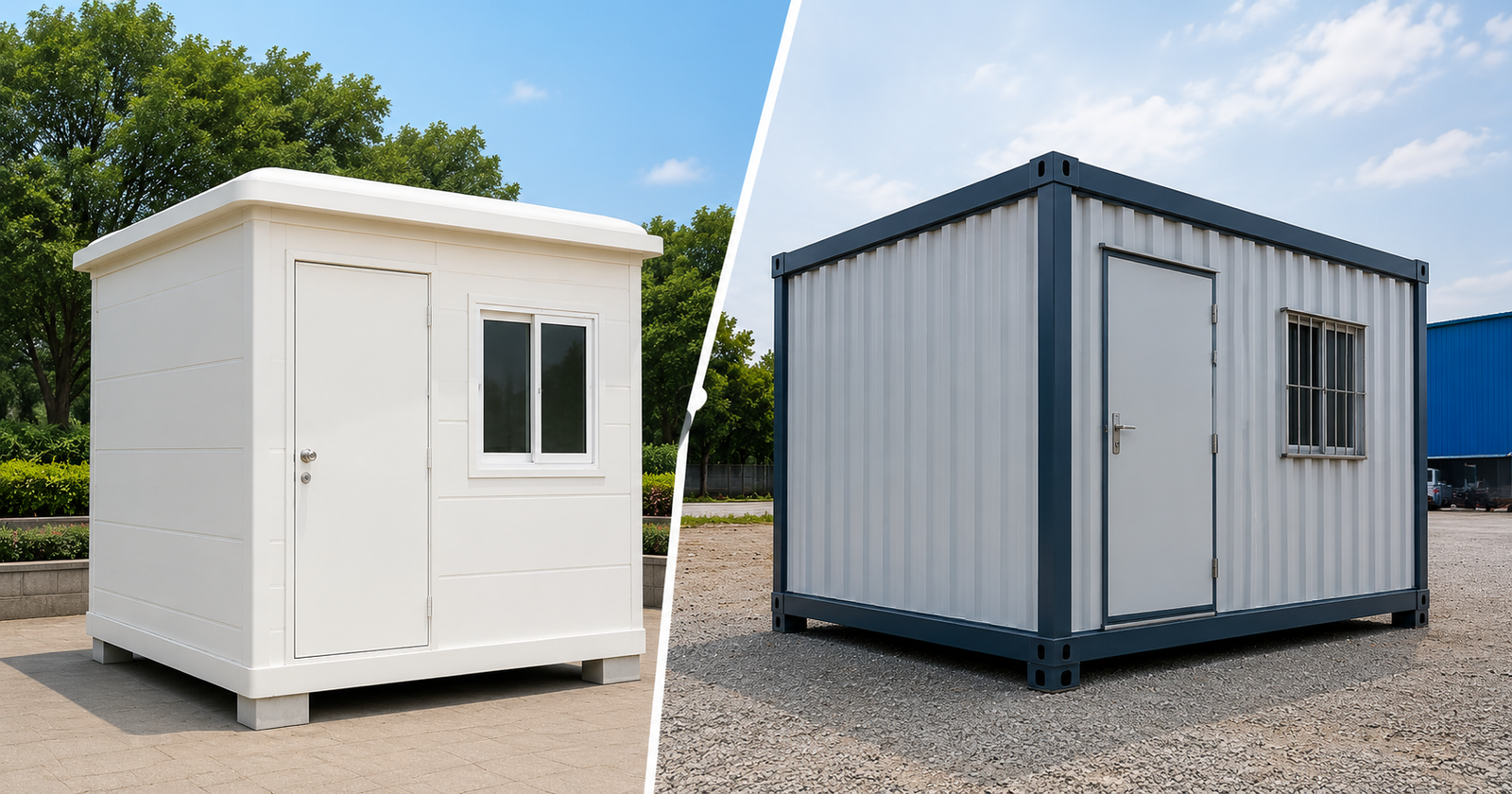
Here we discuss the practical comparison between FRP (Fiber-Reinforced Plastic) cabins and steel portable cabins. You will get a clear idea of these two cabins after going through this blog. After explaining what FRP cabins and steel portable cabins are, we can walk through the key factors regarding their structure, durability, safety, maintenance cost, and thermal insulation. The FRP cabins generally provide comfort and long-term value. A steel cabin is good for its strength and resistance. At the end of this blog, you will get a clear understanding of FRP cabin and Steel portable cabin, and which one to choose for security cabins and site offices according to your specific area.
While comparing FRP cabin vs steel portable cabin, you must be aware of the geological conditions of the area and the budget. FRP cabins, also known as Fibre Reinforced Plastic cabins, are great for corrosion resistance and thermal insulation. The steel portable cabins are good for their strength and fire resistance. We can say neither of them is better; each of them has pros and cons. We will discuss that in the coming session.
What is an FRP Portable Cabin?
FRP cabins are made up of fibre-reinforced plastic. It is a mixture of fibreglass strands and a resin matrix. It is very lightweight and not vulnerable to corrosion. FRP cabins are resistant to many chemical reactions. They are most commonly used in site offices at construction projects and as security cabins. They can be assembled and can be easily relocated with less effort.
What is a Steel Portable Cabin?
Steel portable cabins are made from galvanised steel frames. Their walls and roofs are constructed from steel sheets. The Steel Portable cabins are known for their robustness and rigidity. These are perfect for heavy-duty industrial environments. They are applicable to factory control rooms and security cabins in industrial areas. Steel cabins can also be constructed for long-term installations to provide greater stability.
FRP Cabin vs Steel Portable Cabin
Here is a comparison between the key factors regarding the durability, thermal insulation, strength, maintenance, and cost of the FRP cabins and Steel Portable cabins.
Durability and Corrosion Resistance
FRP Cabins are resistant to many natural chemical reactions. They prevent rust and moisture. Highly recommended in humid climates and coastal environments. Meanwhile, steel cabins are vulnerable to corrosion.
Prevention of corrosion in steel cabins requires galvanisation and painting or other protective coatings. If not properly maintained, the steel can corrode and increase your maintenance costs. In conclusion, FRP cabins outperform steel cabins in terms of durability in humid conditions.
Electrical and Thermal Insulation
FRP cabins don’t allow heat to transfer easily. This helps to keep the cabin cooler on summer days and improves energy efficiency. These cabins also assist in good electrical insulation.
Steel cabins easily conduct heat and electricity, leading to an increase in temperature during summer and a decrease in temperature in winter. To prevent this, the roof and wall panels must be insulated. But this adds more to the cost than installing FRP cabins. FRP cabin is again the winner in regard to thermal insulation and energy efficiency.
Weight and Relocation of the Cabins
The FRP cabins have a distinct edge in Weight and relocation of the cabin compared to steel cabins. We can see clearly that FRP cabins are ¾ lighter than steel. It makes them easier to transport and relocate. Eventually leading to lower logistics costs and quick deployment.
Steel cabins are much heavier and more robust. Due to their heavy nature, relocation is difficult and costly. Costs for labour and heavy equipment for moving are higher than those for FRP cabins. FRP cabins are better and more convenient if you need regular relocation of cabins.
Strength and Resistance to Fire
Steel cabins are a better option if you prioritise strength and safety. Steel cabins perform better under heavy loads due to their structural strength. Steel cabins are resistant to fire, making them important in industrial areas. They are non-combustible in nature.
FRP cabins are typically less rigid. They are not non-combustible like steel, but can withstand fire to a great extent. In fire-risk areas, practical recommendations include steel cabins. Steel cabins are the winner in fire-sensitive environments and for heavy industrial usage.
Maintenance
For long-term value, maintenance cost and lifespan matter a lot. FRP cabins do not need any additional painting or coating and are easy to maintain. They are perfect for humid and corrosive environments, thus reducing lifecycle costs.
Steel cabins need protective coatings to prevent them from rusting. They need to be maintained properly. They are generally of a shorter lifespan compared to FRP cabins. FRP cabins are good for low maintenance in challenging climates.
Cost
FRP cabins are higher in initial material costs than normal steel cabins. But maintenance and installation costs are lower compared to steel cabins. The lifecycle cost of Steel cabins is higher than that of FRP cabins. Considering all these factors, FRP cabins provide a better long-term value. In humid regions, FRP cabins are better if budget is a matter for you.
Where to Choose FRP Cabins?
You can choose FRP cabins in humid, coastal areas. Good thermal insulation is needed to improve comfort. In that scenario, FRPs are better. If you want low maintenance, electrical insulation, and frequent relocation is a concern, FRP cabins are best.
Where are Steel Cabins Good?
If the environment is dry and there is limited exposure to salt and other chemicals, steel cabins are preferable. In fire-prone and high-risk areas, steel cabins are inevitable. They are known for their rigidity and structural strength.
Conclusion
The final decision between FRP cabins and steel portable cabins heavily depends on your area and location. FRP cabins are good for temporary security or site office solutions. They require less maintenance and regulate the temperature inside the cabin. Steel cabins are good if you need a strong, rigid, fire-resistant cabin for your purposes. To conclude, one is not superior to the other, but can be, according to your environment and priorities.
FAQs
1. Which is better, an FRP cabin or a steel portable cabin?
The better choice depends on your environment, budget, and whether you prioritise insulation or structural strength.
2. Are FRP cabins suitable for coastal areas?
Yes, FRP cabins are highly resistant to corrosion, making them ideal for humid and coastal environments.
3. Do steel portable cabins require regular maintenance?
Yes, steel cabins need periodic painting or protective coatings to prevent rust and corrosion.
4. Which cabin provides better thermal insulation?
FRP cabins provide better thermal insulation, helping maintain a more comfortable indoor temperature.
5. Which cabin is easier to relocate?
FRP cabins are lighter than steel cabins, making them easier and more cost-effective to transport and relocate.
Read More:
Also Read :Portable Site Office Cabins: Complete Guide for Construction Businesses